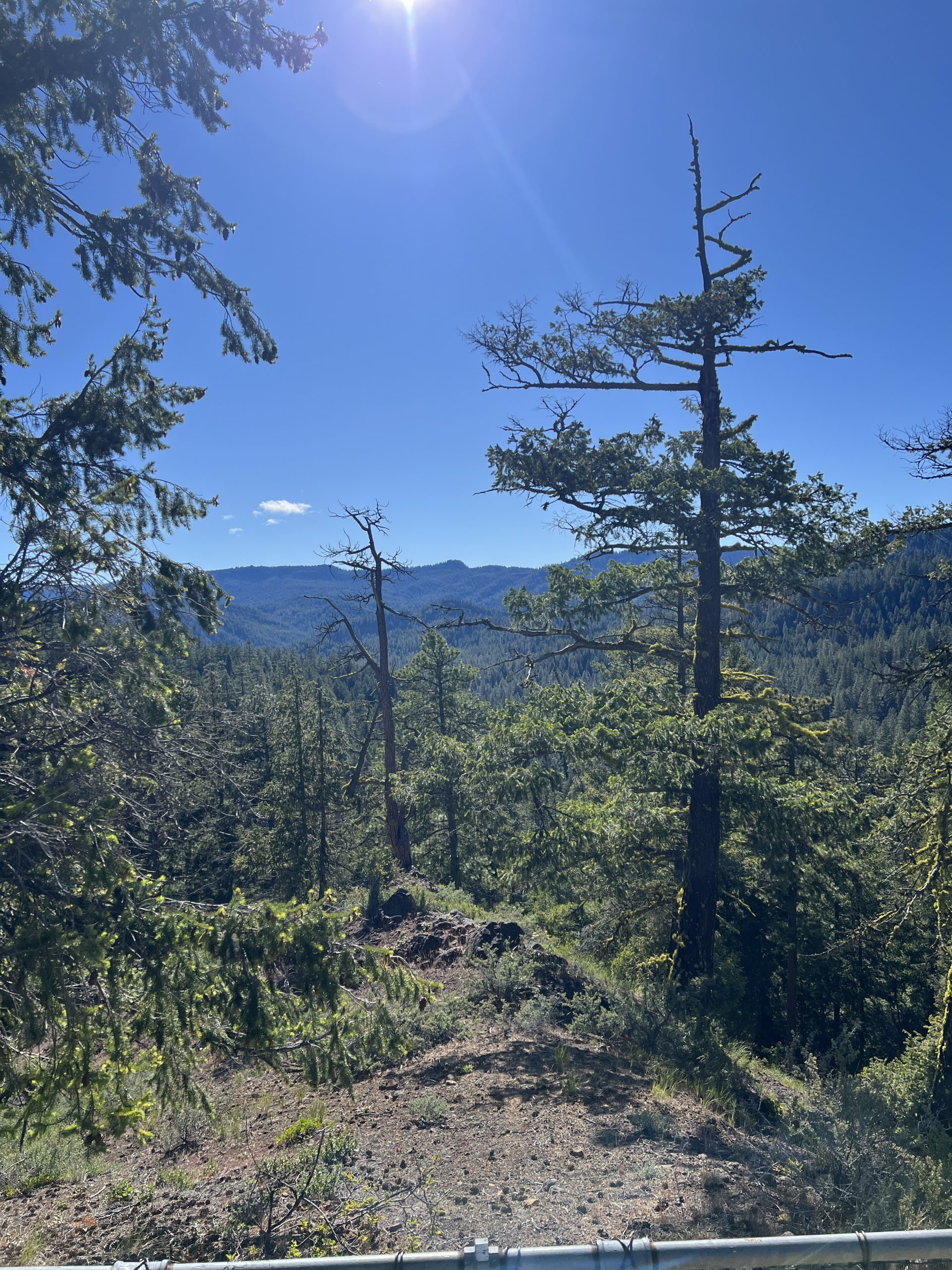

I was standing on top of a mountain, looking across a valley to a distant ridge.
From where I stood, I could see only the peaks. Everything below was hidden by Douglas firs and Ponderosa Pines.
I remember wondering what it must have been like for the first people who crossed country like this. They couldn’t see the whole route. They simply looked at a distant mountain, set a bearing, and walked.
Then I smiled to myself.
“I’ll never do that.”
The thought came with a bite of my own mortality.
I’m too old. Too out of shape. Not eager to trek the wilderness.
The idea fascinated me, but I still deemed it impossible.
An hour later, I approached the end of my hike—or so I thought.
Because of some bad information, I missed the trailhead and inadvertently started down another trail. I didn’t realize there were two until I was already committed.
About thirty minutes in, a bear cub stepped onto the path and peeked out from the woods. I startled it, and it ran away.
Should I turn around? I thought.
The way back was closer than the way forward.
Instead, I picked up my pace and kept walking.
If their was a cub, a mother was nearby.
A few minutes later, as I put distance between the cub and me, I came to a second obstacle.
The trail dipped between two hills where fallen trees had once blocked the way. Someone had cut the trunks and cleared the path, but today there was a stretch of dark standing water eight or ten feet across.
Again, I wondered if this was a sign to go back. No — go forward.
Then I noticed the logs.
They lay alongside the trail, three maybe four, just off the path where they had fallen.
The trail wasn’t closed. It simply required a different way through, a more careful step.
So I stepped onto the logs and continued.
An hour later, the sounds of people were gone. The creek had faded into the distance. There was no traffic rumble, no train horns, no conversations—only the wind in the trees.
Then I realized something.
I could once again see over the valley to the hilltops 30, 40, maybe even 50 miles away.
Without intending to, I was living the very experience I had imagined on the mountaintop. I was crossing from one ridge to another, exploring country I had never seen and finding details I could not have imagined
That hike has stayed with me because it showed me something important: life works the same way.
People often talk about “finding yourself” as though it’s a mystical experience. I don’t see it that way.
I think many of us experience something more practical: a persistent pull toward the work we do without being asked, certain problems we want to solve, certain places we feel compelled to go, or certain ways we want to serve. It keeps returning, even when it’s inconvenient.
I’ve come to think of that as the call.
The call isn’t something mystical.
It’s practical
Not wishful thinking.
A direction.
The mistake is believing you must see the entire path before taking the first step. But trails don’t work that way. You discover them by walking.
The uncertainty, the setbacks, even the wrong turns aren’t necessarily signs that you’ve failed. They’re often part of learning the terrain shaping you into the kind of person who can continue the journey.
That’s why I don’t think the call is about escaping reality or chasing a fantasy.
I think it’s about entering reality more fully.
The things that keep drawing your attention may not be distractions from life. They may be invitations into the life you’re meant to build.
And that life doesn’t appear all at once.
It unfolds one step at a time.
Sometimes you just need to keep walking.
Sometimes you need to cross on the logs that are already there.
That’s what Vision as a Lifestyle means to me.
A vision isn’t something you visit on weekends or squeeze in after work. It’s something you pursue until it reshapes the way you live. As you walk the path, you gain skills, perspective, endurance, and opportunities that couldn’t have been acquired any other way.
Eventually, the vision isn’t just something you believe in.
It becomes the way you live.
Looking back, I don’t remember the bear as an obstacle. I don’t even remember taking the wrong trail.
What I remember is finally standing in the place I had once only imagined from a distant mountaintop.
Sometimes that’s how vision works.
If you take the persistent direction in your life seriously you discover, step by step, that it leads to something real.
Something sustaining
You don’t need to see the whole trail.
You only need enough courage to take the next step.
Leave a Reply